
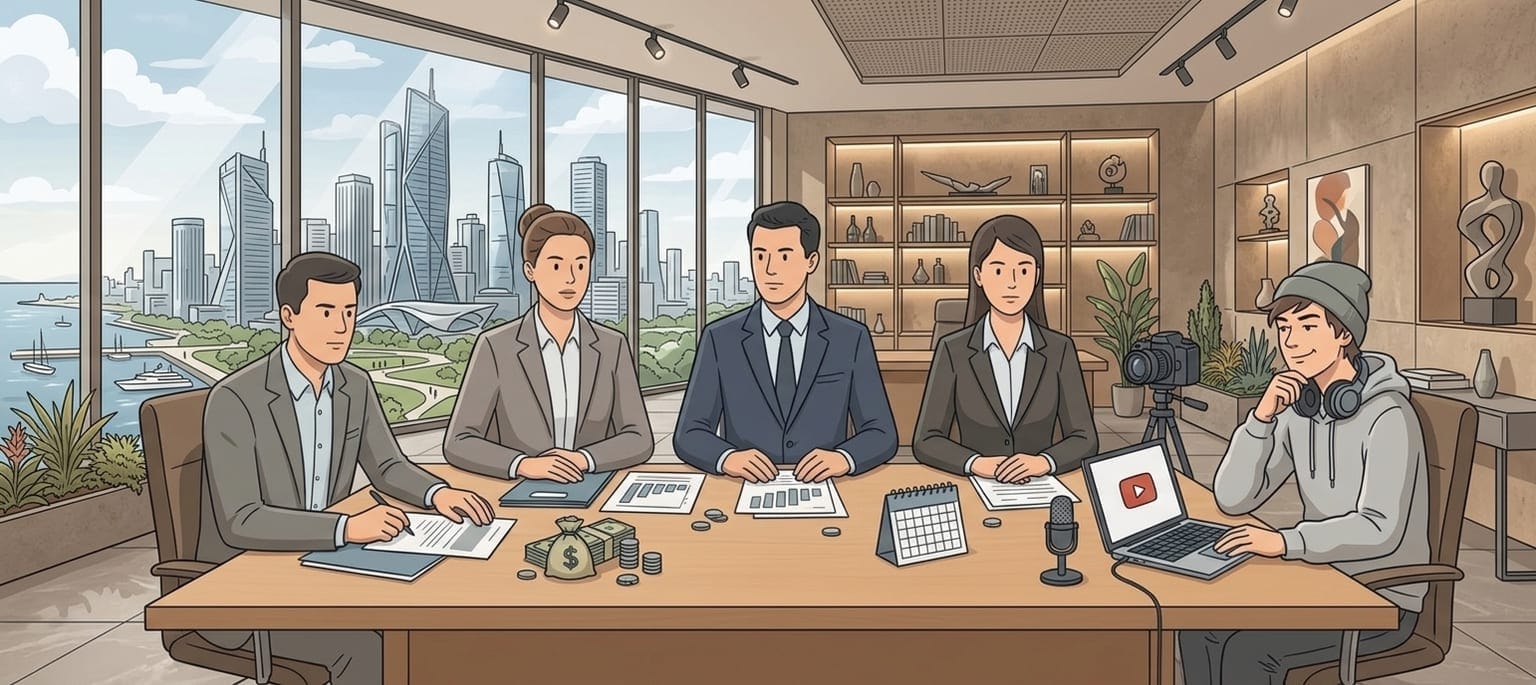
You've found the right creator. You've checked their numbers. Now they've replied asking what you had in mind, and you have no idea what to say.
Say a number first. Knowing how to negotiate with YouTubers really comes down to arriving with one you can actually defend.
- Open with a defensible offer instead of asking for their rate.
- Price it from recent average views times niche CPM, and show your working.
- If it's too expensive, cut scope rather than price.
Most brands do the opposite. They ask "what are your rates?", get a number with no explanation, and then either pay it or haggle blind. You've handed over the anchor before you knew whether it was reasonable.
For the pricing model behind everything below, see what sponsors pay YouTubers, or our complete guide to YouTube sponsorships if you're new to how these deals work.
Why You Should Name the Number First
Whoever speaks first sets the frame. That holds in any negotiation, and it holds double here because creator pricing is opaque enough that both sides are often guessing.
An unexplained number invites haggling. A number with visible math invites a conversation about the inputs.
Compare these two openings:
"What's your rate for a sponsored integration?"
"Based on your recent average of about 180,000 views and typical rates in tech, we'd be looking at around $6,300 for a standard 60-second integration. Does that work as a starting point?"
The second one does three things at once. It shows you did the homework, it puts a defensible figure on the table, and it tells the creator you're not going to waste their time.
What Range Should You Anchor In?
Here's what channels actually command, by size. Use it to sanity-check before you open, not as a quote.
| Channel size | Median | Middle half (p25-p75) |
|---|---|---|
| Mid (100k-1M subs) | $3,120 | $1,170 - $6,696 |
| Macro (1M-10M) | $15,623 | $5,800 - $39,736 |
| Mega (10M+) | $93,385 | $35,472 - $227,882 |
Look at how wide those ranges are. Mid-tier channels span nearly 6× from the bottom of the middle half to the top, and they're all in the same subscriber bracket.
That's the whole reason subscriber count is a bad basis for an offer. Two channels with 400,000 subscribers can be worth $1,200 and $6,700 respectively, and the difference is simply how many people watch.
So price the views. Ask for their last ten videos, take the median, multiply by the niche CPM, divide by a thousand. Model it on the sponsorship calculator if you want the format and placement multipliers applied too.
What Do You Trade When the Price Is Too High?
Trade scope, and only scope.
If a creator's number is above your budget, the instinct is to ask them to come down. Don't. You're asking them to say their own rate card was inflated, and creators who agree to that quickly are telling you something unflattering about their pricing.
Trade these instead:
- Format. A 30-second mention runs about 0.7× a standard integration. Semi-dedicated is 1.75×, dedicated 2.7×. Stepping down one level is a real saving for a real reduction. See what each format costs.
- Placement. End-roll costs about 0.7× of mid-roll. If your product doesn't need prime positioning, that's money back.
- Usage rights. If you don't intend to run the video as a paid ad, don't buy the rights. That alone can be a large share of the fee.
- Timing. Flexibility on the publish date is worth something to a creator juggling a content calendar.
- Volume. Multi-video deals discount roughly 5% for two, about 10% for three, and near 18% for five.
Each of those hands the creator a reason to say yes that isn't "I overcharged you in the first place."
Don't buy usage rights cheaply by leaving them vague. An unclear rights clause is the most common source of post-campaign conflict. The brand assumes it can run ads, the creator assumed organic only. Price it explicitly or exclude it explicitly.
What Creators Are Actually Worried About
Understanding the other side of the table makes this much easier, and the concerns aren't the ones brands expect.
Looking cheap to their audience. A creator's most valuable asset is the trust that makes a recommendation land. Promoting something that doesn't fit costs them more than your fee is worth. When a creator hesitates, it's often this, not money.
Being asked to work for free. "Exposure" and "we'll send you product" are, to a working creator, requests to donate their audience. If your budget genuinely is product-only, say so immediately and aim at smaller channels where that's a normal first deal.
Getting stuck in approvals. Nothing kills a creator's willingness to work with a brand again like four rounds of notes on a 60-second segment. Promising a single round of factual corrections is worth real money in goodwill, and it costs you nothing.
Not getting paid. Late payment is endemic in this industry. Offering half upfront, unprompted, moves you ahead of most brands they deal with.
Two of those four concerns cost you nothing at all to fix, which makes them the cheapest leverage available, and most brands ignore them entirely.
Three Openings That Get Better Answers
The wording of the first message does a surprising amount of the work.
Instead of "what are your rates?": "We're budgeting around $X for a 60-second integration based on your recent averages. Does that fit how you price?" You've anchored, shown your math, and invited a correction rather than a haggle.
Instead of "that's over budget": "That's above what we can do at this scope. Would a 30-second mention at $Y work, or an end-roll placement instead?" You've kept their rate intact and changed the product.
Instead of "can you do better on price?": "If we booked three videos across the quarter, what would that look like?" Volume gives them a reason to discount that doesn't undermine their card.
Notice that none of those openings asks the creator to be worth less. Each one changes what's being bought instead, which is a conversation people can actually say yes to.
Where the Real Leverage Is
I'm going to be blunt here: on a single video with a well-known creator, you have very little leverage. They have other buyers.
Your leverage comes from three places instead.
Being easy to work with. Fast approvals, clear briefs, prompt payment. Creators talk to each other, and a reputation for painless deals gets you access that money alone doesn't.
Committing to more than one video. A bundle is worth more to a creator than a single booking: predictable income, one negotiation, one onboarding. That's why the discount exists.
Finding them earlier. Check who already sponsors in your category on top US channels by niche, because a creator with existing brand deals negotiates faster. The strongest position in this whole process isn't negotiating harder. It's shortlisting channels before they have a queue of brands. A creator with no inbound is a very different conversation from one fielding five offers a week.
👉 Find Creators Now and build that shortlist before someone else does.
Getting to Yes Without Losing the Room
Three habits that keep the conversation productive.
Ask what budget they're working with before you move. If your offer is $4,000 and they wanted $12,000, no amount of clever trading closes that. Find out early rather than after three emails.
Put the offer in writing on the first reply. Number, format, placement, usage, timeline. Ambiguity costs more than a low offer does.
Don't win too hard. A creator who feels squeezed delivers the contractual minimum. The segment will be technically compliant and completely flat, and that costs you more than the discount was worth.
Final Takeaway
Negotiating with YouTubers is mostly about arriving prepared rather than arguing well.
Open with a number you can explain. Anchor it in their real average views and their niche's rate, not their subscriber badge. When the number doesn't fit, change what you're buying instead of asking them to devalue what they sell.
And remember where the actual advantage sits: not in the haggle, but in finding good creators before the queue forms.
Bottom line: cut scope, not rate.
Once you agree a number, put it in writing with the YouTube influencer contract checklist, then set expectations with a sponsorship brief. Curious how the other side sees it? How creators land their first sponsorship is the same negotiation from the opposite chair.
Frequently Asked Questions
How do you negotiate with a YouTuber?
Open with a defensible number instead of asking for theirs. Price it from recent average views × niche CPM and show the working. Then negotiate scope (format, placement, usage rights) rather than asking for a discount.
What is a fair price for a YouTube sponsorship?
It scales with views, not subscribers. In our index the middle half of mid-tier channels runs about $1,170-$6,696 with a median near $3,120; macro channels about $5,800-$39,736 with a median around $15,623.
Should I ask a YouTuber for their rate first?
Usually not. Whoever names the first number sets the anchor. Come in with a defensible offer, and if they quote higher you've got a discussion rather than a blank page.
What do you do if a YouTuber's rate is too high?
Cut scope. Drop to a 30-second mention at about 0.7×, move to end-roll at about 0.7×, or shorten the usage window. Each lowers the fee for a real reason.
Do YouTubers negotiate on price?
Most negotiate on structure rather than headline rate: bundles, usage windows, performance bonuses, timing. A creator who drops 40% on one video has told you their rate card was fiction.